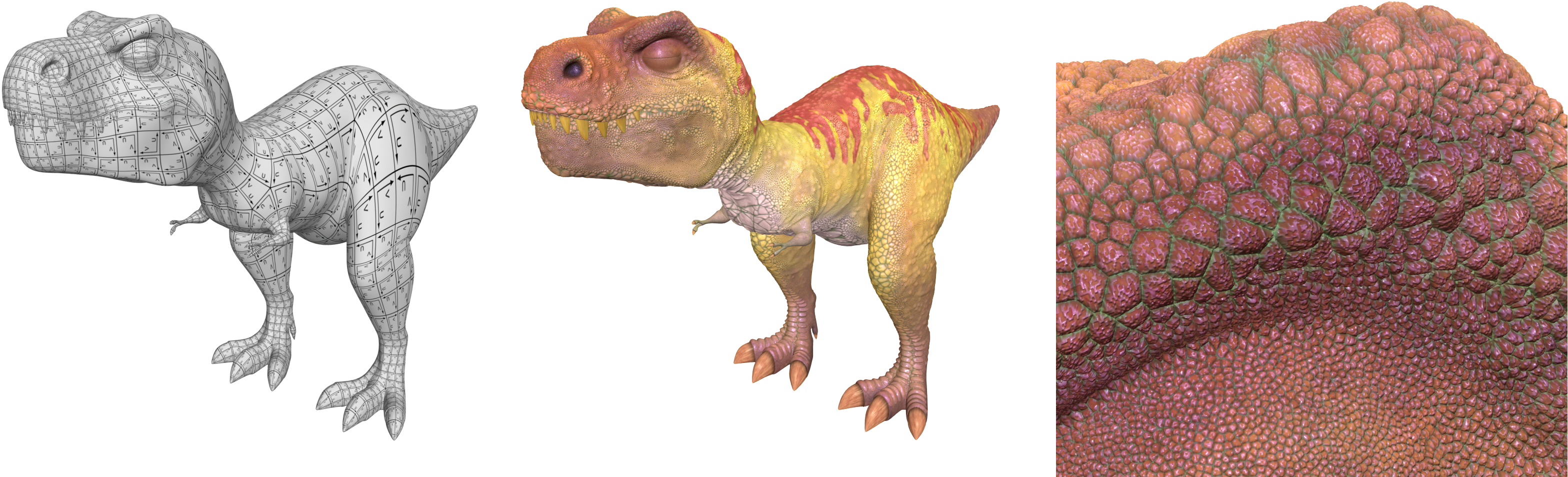
Model with 2694 faces rendered with Ptex. No explicit UV assignment was used. The largest texture layer, the fine-scale displacements, has 836 million texels stored in a single Ptex file with individual face resolutions ranging from 64 x 64 to 2048 x 2048 texels. No seams are visible across faces, even under close magnification.
(© Walt Disney Animation Studios)
Motivation
There were many drawbacks to traditional texture mapping methods that led to the development of Ptex:- UV assignment was a tedious task, and making good UVs on complex models was difficult.
- Texture seams could produce visible artifacts especially with displacement maps.
- Large numbers of texture files were required creating a significant I/O bottleneck.
Ptex was used on virtually every surface in the feature film Bolt, and is now the primary texture mapping method for all productions at Walt Disney Animation Studios.
Major Features
- Supports Catmull-Clark subdivision surfaces (including quad and non-quad faces), Loop subdivision surfaces, and polymeshes (either all-quad or all-triangle).
- Several data types are supported including 8 or 16-bit integer, float, and half-precision float.
- An arbitrary number of channels can be stored in a Ptex file.
- Arbitrary meta data can be stored in the Ptex file and accessed through the memory-managed cache.
